
The Heritage Park Intranet

|
The Heritage Park Intranet |
|
||||
| Artefacts | Archives | Masters | History | Notices | ||
Welcome to Pitstone and Ivinghoe museum society and thank you for volunteering to be one of the people working at the farm, running our wonderful museum. We are not highly regulated or strictly monitored so be aware of potential hazards as you move around a site designed and built before health and safety became a major issue.
There is a job board located by the catering passage and a folder in reception listing some of the jobs that need doing but don't treat it as a bible, there are probably jobs that have been done and others not listed, please use your initiative when deciding what to do, if in doubt, ask us!
If you are doing ground maintenance, bear in mind that we go for a fairly relaxed, rustic look to the site: we feel we like to point nature in the right direction rather than trying to control it. We don't want a sterile, manicured look, we try to eliminate things like stinging nettles and brambles but let cow parsley and ivy go their own way chopping them back when required.
When visiting the Museum, please park on a hard standing area where possible, never park in the drive and keep off the grassy areas of the main museum site in the winter or very wet periods. If we run out of space, use one of the orchards. Record sheets are kept in Reception where volunteers and visitors are expected to sign in and out. These are for the purpose of maintaining an accurate record of who is onsite at any given time and are a necessary adjunct to disaster prevention planning. They also allow us to keep a current account of serving volunteers
If you have any suggestions or complaints, do not hesitate to voice them to any member of the committee.
Enjoy your time at Pitstone and thanks for volunteering: -
| The Museum | |
| Volunteering | |
| Health & Safety | |
| Supporting Documents | |
The museum is a tenant of the National Trust and holds a 99-year lease on the buildings. We do not now have organisational links with the Pitstone Windmill or Ford End Water Mill, both of which are looked after by separate bodies.
The farmhouse on the opposite side of the drive belongs to the Hawkins family, with whom we have a good relationship and volunteers are asked to respect their routes of access and property.
The society holds a series of monthly talks, on a Thursday afternoon or evening, about matters pertaining the local area. These take place in the Meeting Room. Details can be found on the Museum website under the ‘Society” menu.
The week day running of the museum is handled by the site manager, who reports to the EC and has an overview of the work programme and the disposition of resources. For most volunteers who may need clarification of their roles or indeed any queries, the first point of contact should be with the site manager or a Committee Officer.
The society that runs the museum (PIMS) is an official registered charity number 273931 and must be run on conventional business principals and so we have an executive committee (EC) which meets quarterly with an AGM in November. The EC consists of twelve trustees which are detailed on the Charity Commission for England and Wales web site.
We cannot legally run without a properly constituted organisation with elected officers and members together with audited accounts. Please consider seriously the idea of joining the EC Committee so that you can contribute something to our administration.
The current Committee Officers, members and Non-Committee posts are listed in the PIMS Newsletter. Over the last few years, some committee members have had to do 2 or 3 jobs because of the difficulties of filling positions - this is not good for them or the museum in the long term. We have too many people in the older age group and they should be allowed to stand down and enjoy their final years.
Members of the Society are eligible to receive the free Society newsletter and reduced entrance charge for Society Talks. The current membership fees are shown in the Museum website https://pitstonemuseum.co.uk under “Society”.
It should be noted that volunteers at the museum are not automatically members of PIMS unless they have subscribed as members or have been granted membership by the executive committee in recognition of working more than 20 days in a year.
The museum is protected by an alarm system operated from the reception area. Most of the main doors are protected, including the door between the catering area and the pottery area, so if you arrive before the reception door has been unlocked, be careful - a tiny red light on the reception door frame near the lock illuminates when the alarm is set. Only the lead volunteers have a key for reception, whereas most have the general museum keys which open most of the other locks. If you need to enter a room that is not normally opened on a workday, please make sure you lock it up when you've finished and always check that everything in the room is switched off including the lights!
Volunteers are asked to be vigilant in ensuring items that could be used for vandalism or breaking and entry are securely stored away.
Volunteers are reminded that if not visiting the site for an extend period you are requested to return museum keys to a Society Officer.
The Museum website can be found at https://www.pitstonemuseum.co.uk
Our website is the customer facing information portal for potential visitors. The website has an integrated online ticket purchasing system, which event organisers may utilize.
An Intranet is defined as a local or restricted communications network, especially a private network created using World Wide Web software. The Heritage Park Intranet is currently located at: https://www.pims.pitstonemuseum.co.uk Please note that this address should be typed into the Address bar and not searched for. These intranet pages give online access to museum information. There are (at the time of writing) 4121 artifacts excluding slides, photos and archives held by the museum. The Intranet pages are intended for volunteers / members of the Society and are not intended to be accessed by the general public. Due to the content contained they are excluded from being indexed (Googled) and will not be found by search engines.
Intranet main menu headings are:
Artefacts: Information on the artefacts located in the various areas of the museum, according to the information held by the museum Archivist.
Archives: Index to the records that reveal the contents of the drawers and cabinets to access the records held in the museum archives.
Masters: Introduces current documents and provide a source for printing various forms on the printer located in reception. These documents also detail how the museum is operated, directions for the future and plans should a disaster happen.
History: From information and records held in the Archives, some of the history of the area and the farm are published as interactive web pages.
Notices: A notice board providing late - breaking, or current information to volunteers and members of the Society.
Intranet information is presented as: -
Web pages (HTML) - for interactive viewing with enlarged pictures opening new browser page.
Portable Document Files (PDF) - for easy download and printing are presented in a new browser page.
Note: There are some areas of this intranet that are password protected for confidential and security reasons.
Should any one viewing these pages notice any errors, omissions or have ideas on how the information may be improved please drop a line to admin@pitstonemuseum.co.uk
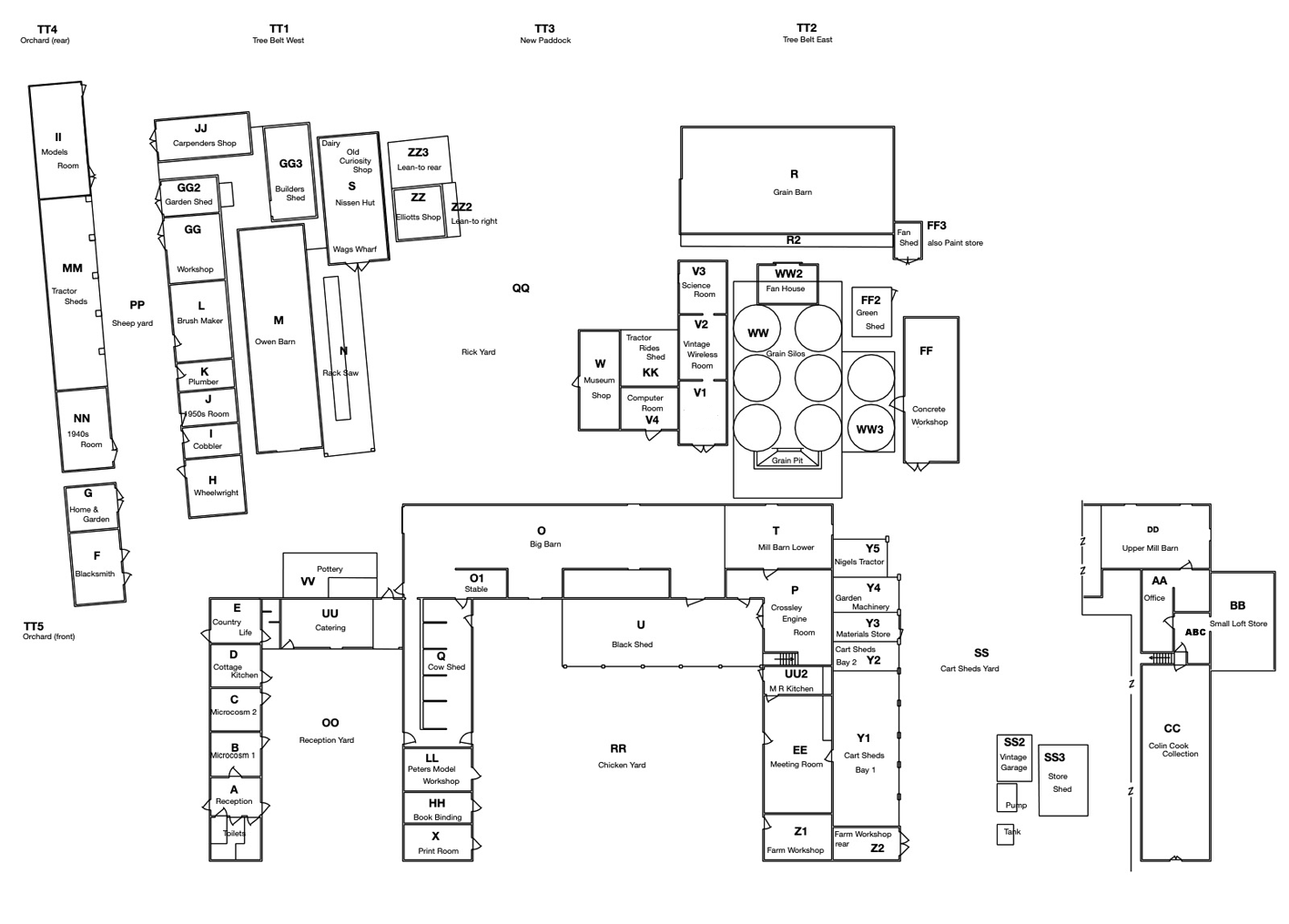
All our artefacts are numbered and all our exhibition areas have a location code (see location map). Our records show not just what we have but where it is. If you need to move an item from one area to another, you must let the Archivist know what you are moving and where you are moving it from and to. Movement Forms are available for printing from the Intranet, under Masters. The completed form should be placed in the Archivist post box in reception.
Artifacts to be considered for donation to the museum should be recorded in accordance with 080 Procedure Object Control and should be in accordance with the Policy for Acquisition and Disposal. Both these documents are available from the ‘Masters” section of the intranet. Please do not bring items onto the site anonymously, as they may well end up in the skip. Items have been found secreted among the exhibits- this will upset our hard working Archivist and may well lose our accreditation. If in doubt please ask the Manager, officers or lead volunteers.
This office is located at the top of the stairs in the Chicken Yard. It’s here that the photographic archives of the museum are kept together with our organisational records.
This area is used by the Secretary, the Archivist and IT Admin. There are three computers in the office which are linked to the internet.
There are facilities for the limited scanning and copying of documents, lamination of A3 and A4 sized sheets of paper and the storage of committee minutes and society accounts.
We retain our hard copies of accession forms as well as maintaining a computer record of all artefacts within the museum. The landline telephone is located in reception.
We couldn't exist without open days and one of the consistent comments about the museum from the visitors is the friendliness and helpfulness of all the volunteers. Our open days are Bank Holiday Mondays and the second Sunday of each month from Easter to October. Please make every effort to be at as many Open Days as you can.
The museum is an accredited museum under the umbrella of the Arts Council. There are a number of websites that provide background to the way such museums are organised.
www.artcouncil.org.uk – overview of governance
www.museumsassociation.org – matters of shared experience
www.southeastmuseum.org – BOB (Beds, Oxon, Bucks) newsletter
www.aim-museums.co.uk – Association of Independent Museums
It is important that an up-to-date register of volunteers is maintained. The following information may be required: -
When visiting the museum on Workdays / Open Days, please sign in and out in the Volunteer Log located in reception.
In the winter we tend to work just mornings on Tuesdays & Thursdays. In the summer we often work for a while in the afternoon as well, as it's warmer and there is more to be done. If you want to work different times let us know and it could be arranged. We sometimes work Sunday mornings, particularly if we have an open day on the Bank Holiday Monday.
Please park on a hard standing area where possible, never park in the drive and keep off the grassy areas of the main museum site in the winter or very wet periods. If we run out of space, use one of the orchards. When you arrive, please sign in, in the folder in the main reception and try to remember to sign out when you leave.
There are tea & coffee making facilities in the reception area and occasionally free biscuits.
The museum has nine open days per year and volunteers are encouraged to attend as many of these as possible. They commence with the Easter Monday Bank Holiday and finish in October. All bank holidays in that period are covered and every second Sunday of the intervening months.
Help is required to staff rooms, reception, catering, the museum shop and various displays. The ethos of the museum is to encourage interest in local history and to provide an educative experience within the context of a relaxing family days out. We aim to achieve these things in a friendly atmosphere by being both courteous and helpful to our visitors.
Mobile Radios are used to establish a quick response from remote parts of the museum, the manager, and first aiders. The list for radio allocation and operation instructions can be found by the Mobile Radio charging rack in Reception. If you are allocated a Mobile Radio please remember to collect at the start of the Open Day and then return (switched off) to the charging rack at the end of the day.
If you need to buy anything for your museum work, ask the manager first, as we may have it already but if the expenditure is agreed keep any receipts in order that you can be reimbursed by the treasurer, you are not expected to buy stuff out of your own pocket.
An expense claim form is available for printing from the Museum Intranet under “Masters”.
The skip is provided for us, free of charge, by a supporter of the museum. They are for the disposal of museum rubbish only. Please do not bring in rubbish from home as we may lose our generous benefactor if they get used for household items, food or vegetable matter.
There is a large bonfire area at the far end of the big orchard which can be used to burn products of ground maintenance, tree pruning etc.
One of our areas of responsibilities is the surface of the main drive. We have spare tarmac chippings, a heavy whacker plate and all the necessary tools to repair the surface and keep it safe and sound and relatively free of potholes.
If you want to put in some time on behalf of the museum but for some reason you cannot come in to work on site, we can, in some cases allow you to take things home to work on, though obviously this has to be strictly controlled and monitored. If you see yourself in this position, don't hesitate to discuss it with the manager. Similarly, if you have a particular interest in one aspect of the museum and would like to carry out a specific project or construct a new display, put some ideas together on paper so we can get a budget agreed and a plan put into place.
This section details additional information requested by our volunteers. Should any volunteer require further information to be added please advise the manager or deputy manager.
The incoming water stop cock is located behind the counter in Reception (location A). An outside tap and hose are located adjacent to the pottery Area (location W).
Volunteers are expected to be responsible for their own safety and as such are urged to wear proper work boots with integral foot protection, provide work gloves for the handling of hazardous items, use safety goggles when operating maintenance equipment and wear hard hats in the appropriate environments. Work clothing should not have trailing edges that could get caught in machines and it is strongly urged that whilst using machinery, rings and watches should be removed. Machinery should only be used after appropriate instruction.
We have some serious machinery on site such as circular saws, routers, welding equipment, tractors, mowing machines, ladders, tower scaffolding etc. Please do not use any of this kind of thing unless you feel that you are sufficiently proficient to be able to do so safely. Working alone on such serious machinery is not permitted. Risk assessments have been carried on various activities which detail safety requirements and methods of working. These risk assessments and procedures must be adhered too. If in doubt, please ask the Museum Manager.
It is within the nature of the buildings that floors are uneven, beams project beyond expected limits and that the points of access may have steps of different dimensions. In order to maintain the built environment in the fashion of a working farm, such areas have been highlighted and made as safe as we can. It is expected that volunteers will exercise a duty of care within the museum and be aware of possible hazards. The site is a strictly no smoking site.
By the first aid kit, in the reception kitchen area is the Accident Book. In the event of a volunteer suffering an accident whilst at the museum, it is mandatory that this record be filled out.
Our qualified first aiders are Mel Davis, Lee Stoffer and Jason Jordan. As above, a basic first aid kit is available in the reception kitchen area.
Defibrillator Location
A defibrillator is available outside the Pitstone Memorial Hall. This is visible from the end of the Museum Drive. If you need the defibrillator dial 999 and give them the defibrillator box number (AAU55) and they will advise the combination to open.
Volunteers are urged to inform the secretary of their emergency contact details together with the name(s) of any person they would wish informed in the event of an accident. Should any volunteer have a medical condition that requires special attention in the case of an accident (e.g., takes blood thinning medication, is diabetic and so forth) he / she should also let the secretary have a note of this. Such information is treated in the strictest confidence.
Various areas and activities within the museum have established safety assessments and procedures. It is intended that these documents will be available on the Museum Intranet.
Please talk to the site manager to establish the proper safety protocols.
Should there be a fire in any part of the museum, everybody is reminded that their first priority is to ensure their own safety and that of visitors / colleagues.
The person discovering the fire should report it to the Site Manager (or a Lead Volunteer) who will contact the fire services as required.
Located in selected areas of the museum are maintained fire extinguishers appropriate to the fire risk in that area. These are for use by only competent trained staff. Please see the Fire Extinguisher Map under Supporting Documents
If instructed please go to the recognised assembly point (Orchard Car Park for Visitors) and wait for further instructions.

| Quick Links: | |||||
| About | Artefacts | History | Master Documents | Terms and Conditions | |
| Accreditaion | Constitution | Interactive Map | Movement Forms | ||
| Archives | Fire Extinguishers | Location Codes | Noticeboard | ||
| © 2025 Pitstone & Ivinghoe Museum Society Pitstone Green Museum, Vicarage Road, Pitstone, Leighton Buzzard. LU7 9EY Registered Charity No. 273931 |
 |